HomeBlog 4 Mistakes That Happens in Absence of Accountant for Self-employed
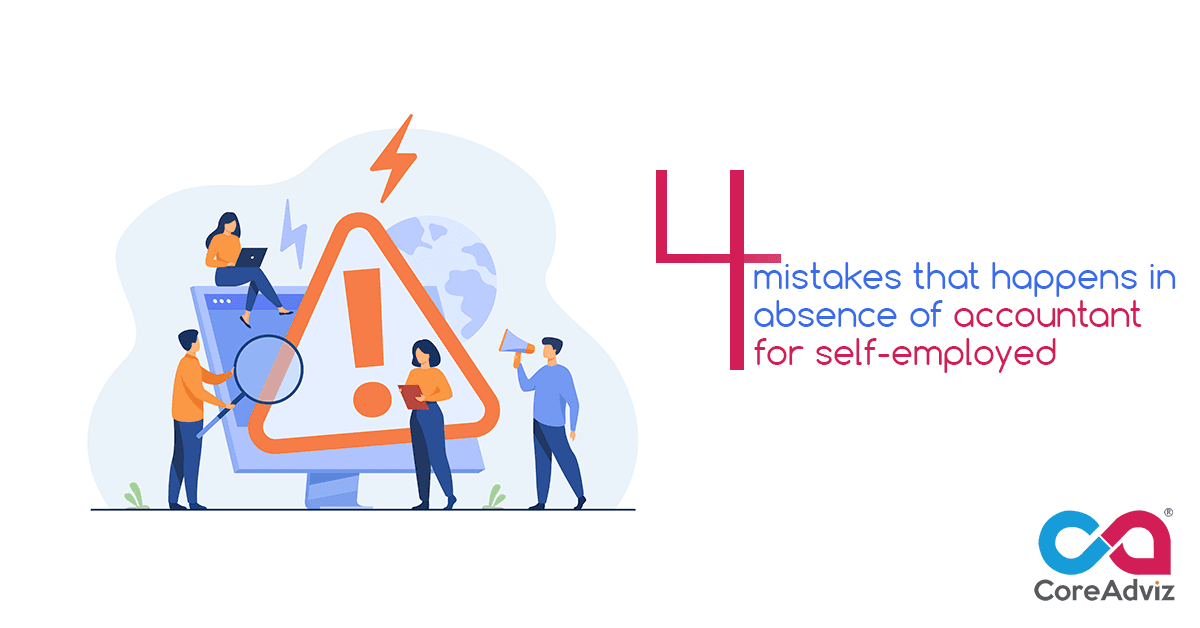
4 Mistakes That Happens in Absence of Accountant for Self-employed

Self employed form of business is a situation where you are own boss. Decision, executions and project acquisition solely takes places on your consideration. However, taxes are required to be paid within its due date and for that accounting becomes an essential tool. Hiring an accountant for self-employed is the most sensible thing to do in today’s scenario as there are numerous compliances, legal changes& guidelines to be kept under consideration including newly introduced changesby the UK during this covid pandemic. Nonetheless, there are some who consider managing the accounts section by self and when such a thing happens, the following is most likely to happe
- Inconsistent Data Recording practices
For people from non-accounting background, it is less likely to comprehend that there are two methods of recording transactions – accrual (traditional) and cash basis. Under traditional form of accounting, transactions are recorded as and when they are affected. Date of sale is considered to be the date of record. On the other hand, under cash basis accounting, date of actual receipt of cash is considered to be the date of record.
As a layman, people often record some transaction under traditional practice and some on cash basis practice. This creates incorrect data for cash flow, resulting in incorrect computation of accounts and balances.
2. Wrong provisions of expenses and income
Being self-employed opens up the avenue of IR35. By now most of the people are aware that their relationship with a particular entity determines whether they fall under the purview of IR35 or not. Factors such as control over work mechanism, certainty over project completion and option for substitution contribute towards determination of IR35 status. People from non-accounting background usually find it difficult to figure out their actual status and end up paying either higher taxation.
3. Incorrect computations while assigning account categories
The modern-day way of accounting has been mostly trusted to softwares. This means that there is a static method of computation that has been embedded into the software to execute the task. Any changes or updates is very less likely to reflect immediately. As a result, people continue to make incorrect computations, such as messing up P&L type accounts with B/S type account.The misallocation of expenses with capita and revenue.The worst part is that they don’t even realize that they are making errors while computing their tax liability.
4. Improper bookkeeping records of transactions
Maintaining a track record of expense with appropriate audit trail is important to keep record for at least 6 years. This will be helpful in deriving your tax payment history, and essentialto refer those records. An accountant for self-employedwill always ask you to maintain separate folders for input & outputVAT payment, personal income tax, bank statements, etc. This means that you will have ready information in case there is an enquiry. Without an accountant’s guidance, the records are mostly lost, damaged or destroyed.
Hiring a professional is essential when it comes to managing accounts. We as a professional accountant provides industry grade easy bookkeeping software to all our clients to use it for free, that keeps records accurate and periodically reviewed by us. Always remember that you are obliged to pay your taxes with the right amount and within the due date. Failure to do so will attract penalties. So, why not avail an expert’s guidance who will not only help you to compute your correct tax liability, but also guide you on investments, financial goals and tax planning.
To know about our range of accounting services for self-employed, click here.