HomeBlog Limited Company for Buy-To-Let Property – Good or Bad Idea?
Limited Company for Buy-To-Let Property – Good or Bad Idea?

Ever since the Finance Act 2015 got updated in 2017 with addition of Section 24, buy-to-let property has become less attractive to landlords. With the introduction of the aforesaid section, landlords can now only deduct 20% their finance cost (including mortgage interest). The eventual outcome of this restriction has severely affected landlords whose income fall under the higher tax bracket. The reason being only a part of finance cost can be used as a deduction for computation of taxable income.
Given the situation, many are of the opinion that landlords should consider creating a limited company and carry out their buy-to-let business via this channel. Why? Let’s figure it out here.
The Good
1. Lower rate of taxation – As per the prevailing laws, limited companies is required to pay corporate tax @19% of its annual income. As a landlord, if his/her annual income falls under the higher tax bracket than the same income would be charged @40-45%. Makes sense?
2. Legal Status – As a limited company, the entities liability is also limited. Therefore, if upset happens the landlord is covered under liability clause. Alternatively, if the landlord uses the traditional method then his liability becomes unlimited.
3. Mortgage Interest adjustments – As cited earlier, the landlords can only use 20% of their finance cost as deduction toward taxable income from rent. In case of a limited company there is no such clause and all concerned expenses (including interest paid on mortgage) can be deducted before the income is considered as taxable.
4. Diversification of income – When a limited company is formed, you can keep your spouse and children as directors/ key stakeholders. This will allow you to diversify your income to them by way of tax efficient dividends, reserves, etc. These will not be a part of your taxable income.
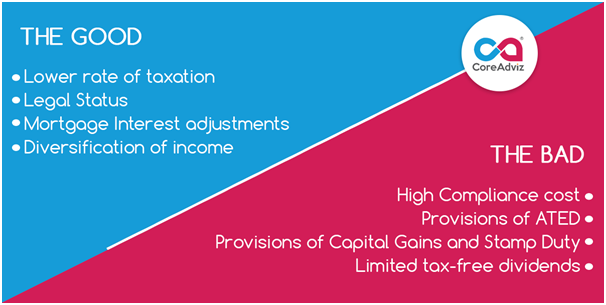
The Bad
1. High Compliance cost – When it comes to a limited company, the entity must abide by the compliances as stated by the respective authority. This involved auditing by compliance officers who take a handsome pay.
2. Provisions of ATED – Annual Tax on Enveloped Dwellings (ATED) is applicable on a company if the buy-to-let property is valued at £500,000 or more.
3. Provisions of Capital Gains and Stamp Duty – A major drawback is that when landlords opt to transfer their existing ownership to a limited company, provisions of capital gains become active. The property is valued at current market price and the applicable tax and stamp duty needs to be paid by the landlord in order to transfer the property to the company’s name.
4. Limited tax-free dividends – When it comes to limited companies, only £2,000 can be claimed as tax-free dividends. Any exceeding amount will attract a marginal tax rate of 32.5% – 38.1%.
Confused? This is why we are here. The decision to create a limited company for buy-to-let property is highly subjective and depends of individual circumstances. Feel free to call: +44 3301331114 and we can sit and take this discussion further over a cup of coffee.