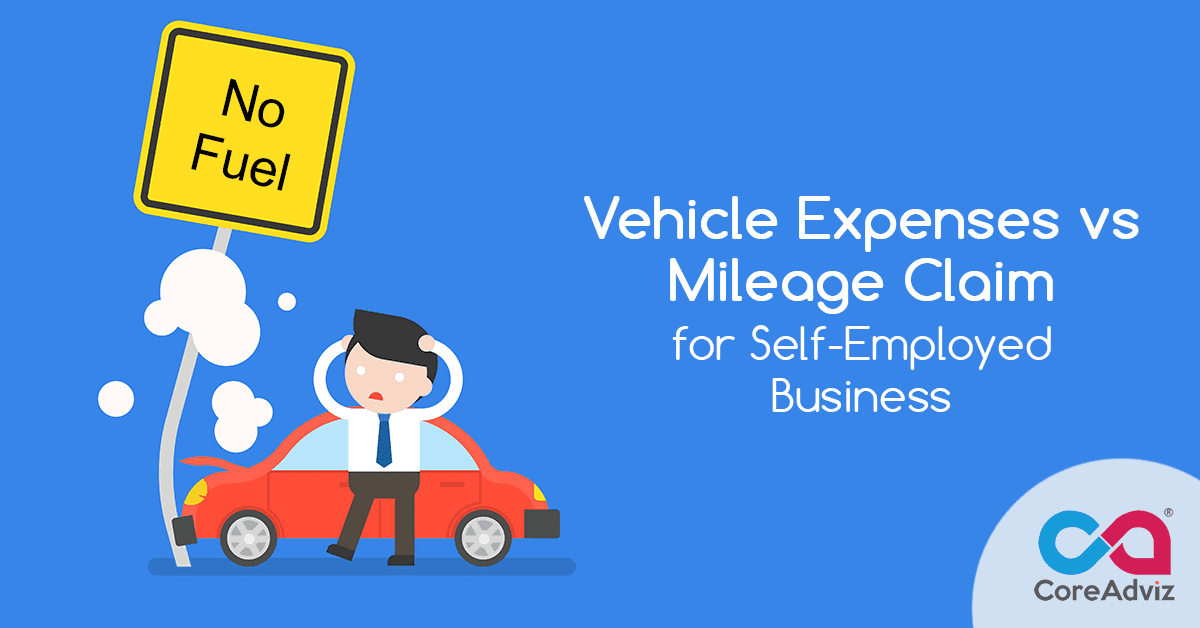
HomeBlog Self Employed Mileage Allowance vs Vehicle Expenses – Which Should You Claim?
Self Employed Mileage Allowance vs Vehicle Expenses – Which Should You Claim?

Understanding the self employed mileage allowance is essential for any sole trader or business owner who uses a vehicle for work. Whether you drive your own car or a company vehicle, choosing between the HMRC approved mileage rate and claiming actual vehicle running costs can make a significant difference to your tax bill. This guide breaks down both methods so you can decide which works best for your situation.
Mileage claim is simplified method that can be used as a deduction while computing tax liability of an individual. However, there are certain questions that comes across in the mind of every individual who is likely to make a claim whether they could make all or only selected such expenses. Let’s discuss some of them here-
What Is the Self Employed Mileage Allowance and How Much Can You Claim?
The self employed mileage allowance is one of the simplest ways to reduce your tax liability without the need to track every fuel receipt or maintenance invoice.
When it comes to claiming mileage expenses, the amount depends on the type of vehicle that you had used for travelling. It can be – car, bike or bicycle and the mileage allowance differs from one medium to the other. As per the latest approved rates by HRMC, the following prevails as flat rate:
| Vehicle Type | Allowance for first 10000 miles* | Allowance post 10000 miles* |
| Cars | 45p | 25p |
| Bike | 24p | — |
| Bicycle | 20p | — |
*Indicated period is a tax year and the mentioned rate is per mile basis
To make things clear, let’s pull up an example.
Suppose Mr Smith used his car for business purpose during tax year 2025-2026 for 12000 miles. So, we would compute available claim as:
10000 x 45p = £4,500 -> as mentioned in table above
2000 x 25p = £500
Total claim = £ (4500 + 500) = £5000
Note: If you use this method for claiming mileage expenses in any of the tax year, then the same needs to be followed until the vehicle is no longer in use for the business.
Can You Claim the Self Employed Mileage Allowance and Running Costs at the Same Time?
HMRC allows you to claim mileage expenses as a deduction to make process as simplified expenses method without the hassle of making paper records. This is an arrangement where rates are fixed as per HMRC. If you are using simplified expenses then allowance for car can be claimed @ 45p/mile for the first 10000 miles within a tax year. Any distance beyond the first 10000 miles will be compensated @ 25p/mile.
There can also be an instance where you have dedicated business use car and maintenance cost to keep that car is higher than your mileage claim. In those instances, business tends to claim running & maintenance cost such as; fuel, insurance, repair & maintenance any other cost to keep the business car running.
There are two optional ways to claim vehicle running cost – either keep using a fixed rate method as approved by HMRC (rates are mentioned above) and second is the direct cost based on actual method.
Under the direct cost method, you first determine the use of vehicle for business purpose and private purpose. Suppose you keep 60% use for business and remaining for personal. Then sum total of the following costs need to be added:
- Fuel
- Insurance
- Road Tax
- Maintenance, etc
60% of the total cost would qualify as allowance. Additionally, capital allowance for the cost of the cars @ 20% of cost per annum on reducing balance method can be claimed.
Can purchase of a Van be claimed as a business capital expense?
Purchase of van for business use can be claimed as a deduction. Under both the forms of accounting – traditional and cash basis, purchase of van would qualify as a business expense and treated under capital allowance. Other areas of expenses such as parking, fuel, etc., would be claimed under allowable business expenditure.
However, if you are intending to use simplified method of claiming flat rate expenses, you are not allowed to make claim of expenses towards Capital purchase cost of car.
I am confused, can somebody guide best way applicable to my business case?
If you are unsure about which method would be best suited for your business, or the process that you should be following then it would be ideal to consult an accountant for self-employed. Note that you cannot claim simplified expenses for a vehicle if you have already claimed a capital allowance for the purchase of the vehicle. Hiring a professional will help you understand the scope and provisions of mileage expense in detail along with managing another aspect of taxation as well – such as tax planning, governance, return filing and submission, etc.
Choosing between the self employed mileage allowance and the actual cost method isn’t always straightforward, as the best option depends on your vehicle usage, annual mileage, and whether you’ve already claimed capital allowances. A specialist accountant can run the numbers for you and ensure you’re claiming the maximum allowable deduction legally.
For a FREE consultation, please get in touch today either via email or dial: +44 3301331114